Almoravid stronghold
Meknès began as an Almoravid military settlement, establishing a strategic nucleus on the Saïss plain from which the later city developed.

Imperial City of Morocco
Meknès reveals itself in layers: monumental walls, refined courtyards, medina lanes, spiritual heritage, craft traditions and a quieter urban rhythm than Morocco’s more crowded destinations. It is a city to read slowly, beyond its most famous gate.
Why Meknès matters
Meknès is often introduced through one monumental image, but the city offers much more than a celebrated gate. Its identity stretches from dynastic history and imperial planning to intimate courtyards, medina routines, religious heritage and nearby landscapes that extend the journey beyond the walls.
That balance is exactly what gives Meknès its appeal. It combines architectural authority with lived scale, making it one of Morocco’s most rewarding cities for travellers who want depth, beauty and a stronger sense of continuity between monument and everyday life.
Meknès does not need to overwhelm to leave an impression. Its power lies in measured rhythm: a wall, a square, a courtyard, a market lane, a mausoleum, a reservoir, a hill view beyond the city.
Historical orientation
Meknès is best understood as a city built in layers. An Almoravid military settlement established the first urban nucleus; Marinid rule added religious and educational institutions to the medina; and Sultan Moulay Ismail later recast the city as an Alaouite capital on an exceptional scale. The result is not one historical image, but a living city where medieval, imperial and contemporary fabrics still meet.
Meknès began as an Almoravid military settlement, establishing a strategic nucleus on the Saïss plain from which the later city developed.
Religious and educational foundations deepened the medina’s urban life. Bou Inania Madrasa preserves this layer through its courtyard, student rooms, zellige, carved plaster and cedarwood.
The Alaouite sultan transformed Meknès into a royal capital of walls, gates, palaces, waterworks, granaries and ceremonial spaces built on an exceptional scale.
UNESCO recognises the historic city for the unusually complete urban fabric and monuments of a seventeenth-century Maghreb capital, where Islamic and European planning traditions meet.
A visual bridge
These images help bridge the historical story and the city you encounter today: memory of dynastic ambition, the long sweep of the walls, and the medina’s intimate spiritual scale.

A visual evocation of the forces that shaped Meknès before its imperial peak.

The city’s long walls still shape scale, procession and arrival.

Close lanes, carved wood and a minaret reveal the city’s quieter lived world.
Meknès at a glance
UNESCO recognition applies to the historic urban ensemble: the medina, the imperial city and the monumental fabric that links them. Meknès matters not because of one gate, but because so much of a capital-city system remains legible.
Moulay Ismail’s reign gave Meknès its defining imperial scale. Walls, royal enclosures, service buildings, water infrastructure and ceremonial approaches were conceived as parts of a larger urban project.
The principal zones are relatively close, yet they belong to different periods and functions. A rewarding visit distinguishes Marinid scholarship, Alaouite power, medina life and the modern city instead of blending them into one story.
Volubilis and Moulay Idriss Zerhoun extend the journey beyond Meknès into Roman, late-antique, Idrissid and sacred landscapes, making the city a strong base for a wider reading of the Zerhoun region.
A clearer reading of the city
To understand Meknès, read its monumental systems, living streets and material culture together. They are not separate attractions: each shows how the historic city continues to function, acquire meaning and remain inhabited.

At Heri es-Souani and across the royal precinct, repeated arches, storage spaces, water infrastructure and massive walls reveal an imperial project concerned as much with logistics as spectacle.

The historic perimeter is still crossed by ordinary movement. Residents, shops, taxis, pedestrians and local routes keep the imperial frame connected to the contemporary city.

Ceramics, cooking vessels, market displays and household objects carry design into daily use, showing how material culture keeps heritage active rather than remote.
Landmarks & orientation
No single monument explains Meknès. These six sites reveal the relationship between ceremonial arrival, public space, imperial infrastructure, dynastic memory and Marinid scholarship.
The ceremonial gateway that gives Meknès its most recognisable image and frames entry to the imperial precinct.
A major public square linking the medina, Bab Mansour and the outward face of the historic city.
A vast granary and service complex whose repeated arches make imperial logistics physically legible.
The large basin beside the imperial service zone, tying water management to scale, landscape and atmosphere.
A royal funerary complex where dynastic memory, devotion and refined interior decoration converge.
A fourteenth-century Marinid madrasa that preserves the city’s scholarly and decorative traditions.


A Marinid interior
Not every major monument in Meknès belongs to Moulay Ismail’s imperial programme. In the medina, Bou Inania Madrasa preserves an earlier Marinid layer. Begun under Sultan Abu al-Hasan and completed under his son Abu Inan, the Qur’anic school brings teaching, residence and ornament together around a disciplined courtyard.
Architectural reading
Long earthen walls, towers, gates and royal precincts create the city’s outward authority. Their impact comes from thickness, continuity and controlled approach as much as from ornament.
At Heri es-Souani and related service zones, repeated arches organise storage, water and movement. Serial form turns practical infrastructure into one of Meknès’s most powerful visual experiences.
Inside madrasas and funerary spaces, zellige, carved plaster, cedarwood and calligraphy replace mass with precision, shifting the city’s language from command to contemplation.
Visual atmosphere


Nearby highlights
Meknès is a strong base for three distinct extensions: Volubilis for the archaeology of ancient Mauretania and the Roman period; Moulay Idriss Zerhoun for an Idrissid and sacred hill-town landscape; and the Middle Atlas around Ifrane and Azrou for a separate, nature-focused journey.
A major archaeological site with monumental streets, civic buildings, mosaics and evidence of many centuries of occupation. Give it enough time to be read as a city rather than treated as a quick photo stop.

Set across the slopes of Jebel Zerhoun, the town is associated with Idris I and the beginnings of the Idrissid state. Its religious importance and steep urban form require a different pace from nearby Volubilis.

For a broader regional extension, continue south toward the Middle Atlas around Ifrane, Azrou and the cedar landscapes. Treat this as a full-day or overnight addition rather than a site immediately outside Meknès.

Practical orientation
Begin with Place el-Hedim and Bab Mansour, continue into the royal heritage zone, then return to the medina for a slower second layer of discovery. Nearby sites work best as a separate half-day or full-day extension.
Go deeper with Exotic Morocco
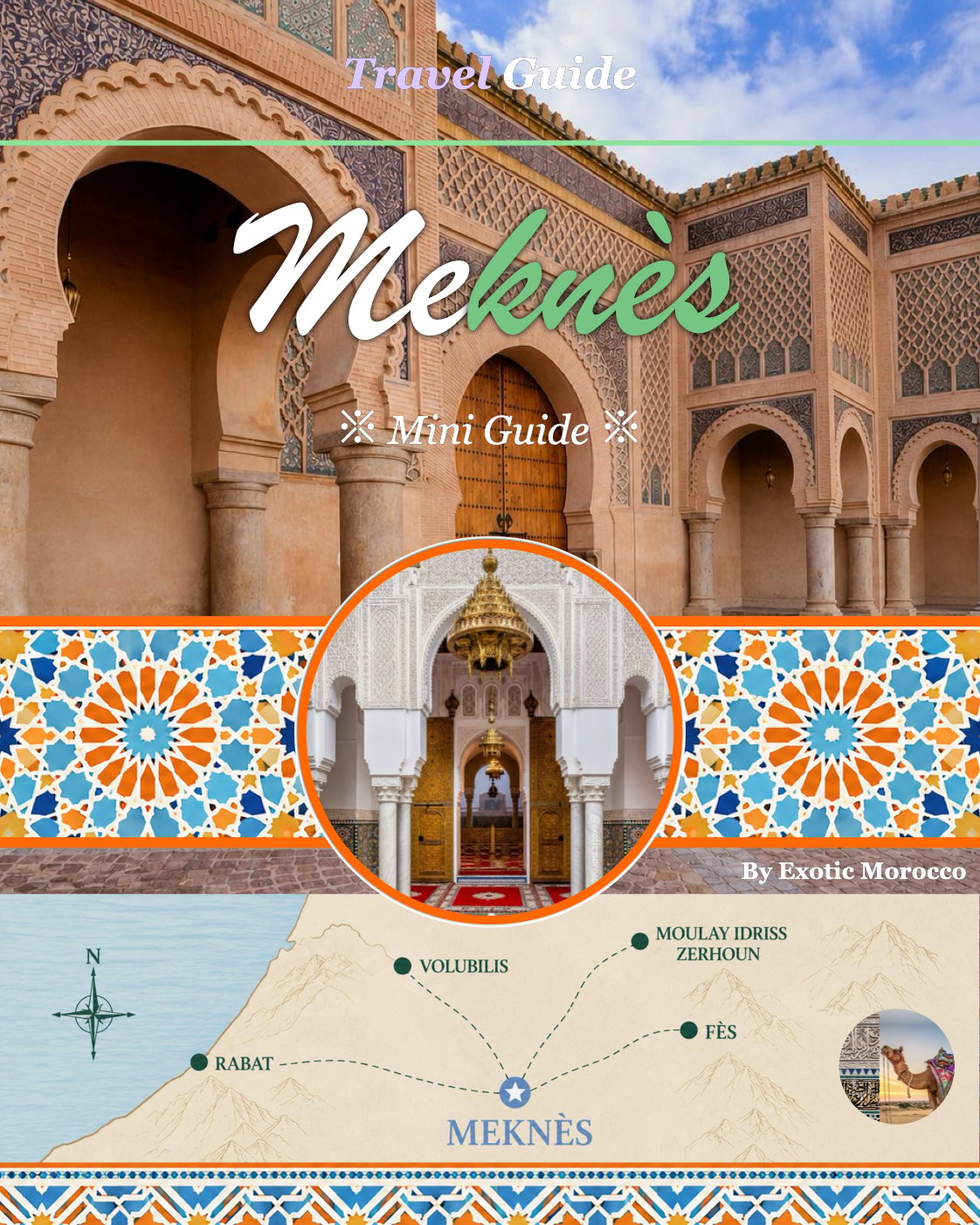
Continue with a complete visual publication designed to connect the city’s history, monuments, architecture, medina life, craftsmanship, practical orientation and nearby heritage into one carefully structured journey.
Continue the journey
Look beyond the gateway and encounter a city of imperial scale, lived heritage, quiet streets, refined interiors and nearby landscapes.